YNAB alternatives (and Mint replacements) for people who hated budgeting
 By Steven Crews, former bank manager and mortgage broker · October 29, 2026
You tried YNAB. Or you loved Mint, and it vanished. Now you want something else, and you would rather not spend another Sunday sorting every dollar into little boxes.
Fair enough. Here are the real options, and who each one suits, including when it is not us.
Why people leave YNAB
YNAB is a good app. Plenty of people swear by it. But three things push people out the door.
- The price. YNAB costs US$109 a year, or US$14.99 a month, plus tax. There is a free trial. Still, paying over a hundred dollars a year to look at your own money feels backward to a lot of people.
- The learning curve. YNAB has its own way of thinking about money. Some people love that part. Others give up in week two.
- Sorting every dollar. YNAB wants every dollar to have a job. Groceries, gas, the dog, the gift fund. If your pay changes month to month, you redo those jobs a lot.
If one of those made you quit, you are not bad with money. You just need a tool that asks less of you.
Mint is gone. Here is what happened.
Mint was the free app most people started with. Intuit shut it down, and users lost access in March 2024. Intuit pointed people to Credit Karma, but the budgeting and the custom categories did not move over.
So if you are typing "mint alternative" into a search box, what you are really missing is a budget, not a credit score. Every app below can fill that gap, and some do it for free.
Budgeting application options
One short card each: price, how it works, who it suits.
YNAB (yes, still). US$109 a year or US$14.99 a month, plus tax, with a free trial. You give every dollar a job, in categories you set up yourself. Best for: people who like detail and want to see exactly where every dollar went. If that is you, stay. The apps below will feel too simple.
EveryDollar. The zero-based budgeting app from Ramsey Solutions. Zero-based means the same thing as YNAB's method: every dollar gets a job before the month starts. There is a free version. Premium is US$79.99 a year and adds bank connect, a financial roadmap, and expert coaching. Best for: Dave Ramsey fans, and anyone who likes the YNAB way but wants it cheaper.
Monarch. A yearly subscription at US$99.99, or US$14.99 a month. Its default budget, which Monarch calls flex budgeting, splits your money into three buckets: fixed bills, costs that come once or twice a year, and one number for everyday spending. That is close to our one-number idea, but it runs month by month. Most people connect their bank accounts, and you can also add accounts by hand. Best for: people who like a single spending number and are happy to link their bank.
Goodbudget. Envelope budgeting on your phone. You put money into envelopes, like the paper kind, and spend from them. The free-forever plan gives you 10 regular envelopes plus 10 more, 1 account, 2 devices, and 1 year of history. Premium is $10 a month or $80 a year and adds unlimited envelopes and accounts, plus automatic bank sync for US banks only. Best for: couples who want one budget on two phones, and anyone who liked cash envelopes but hated the ATM trips.
Actual Budget. Open source, so the code is public and the software is free to use. In their own words, "Actual is a local app, plain and simple." Your numbers live on your own device. Bank sync is optional, through GoCardless in the EU and UK or SimpleFIN in the US and Canada. You can also import QIF, OFX, or CSV files. You run it yourself, or pay for hosting through PikaPods. Best for: people who are fine with a little setup and want to own their data.
A spreadsheet. Free, no login, no company behind it. You build the columns and you make the rules. Best for: people who already like spreadsheets. If you do not, a spreadsheet is easy to stop updating, and a blank sheet does not nag.
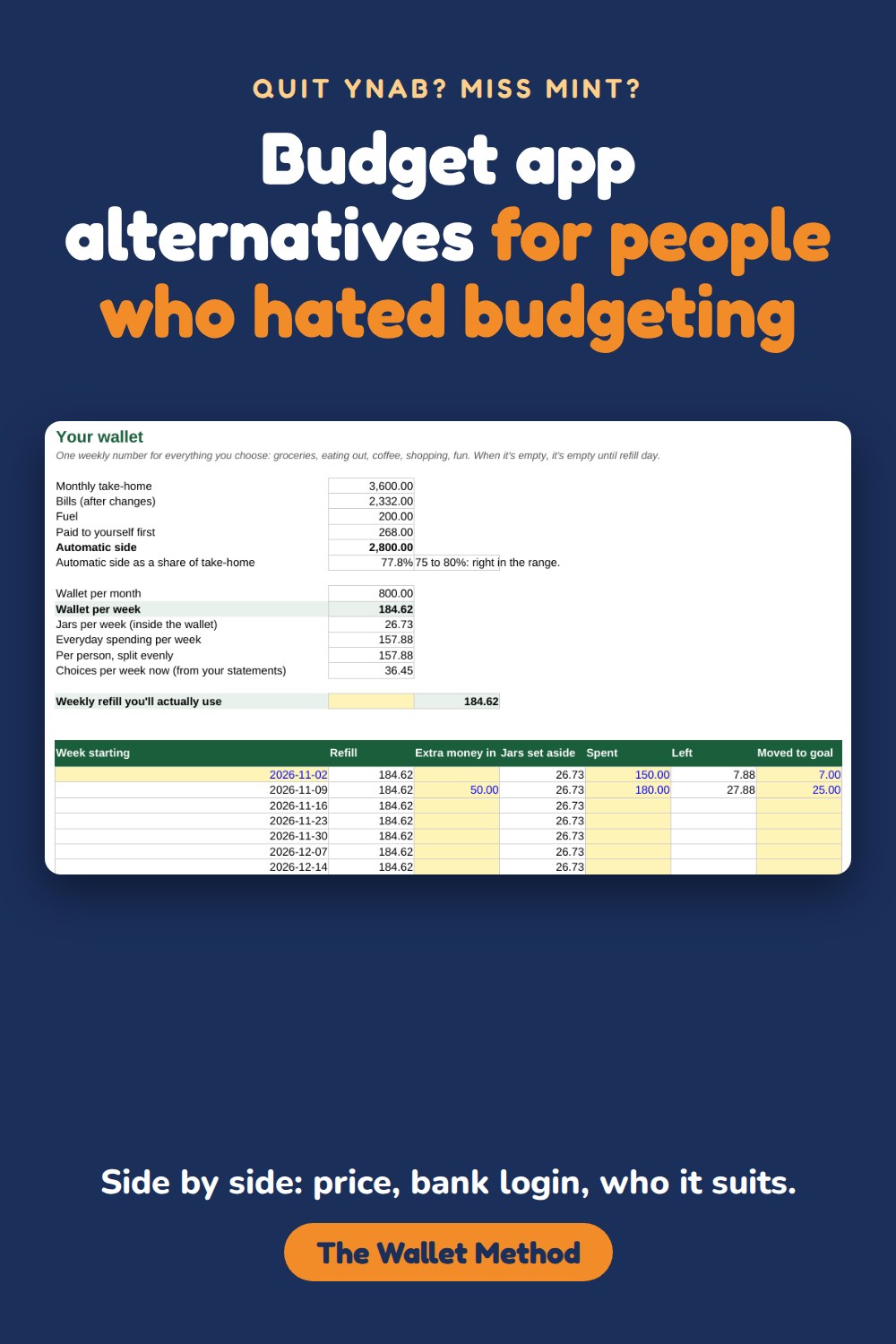
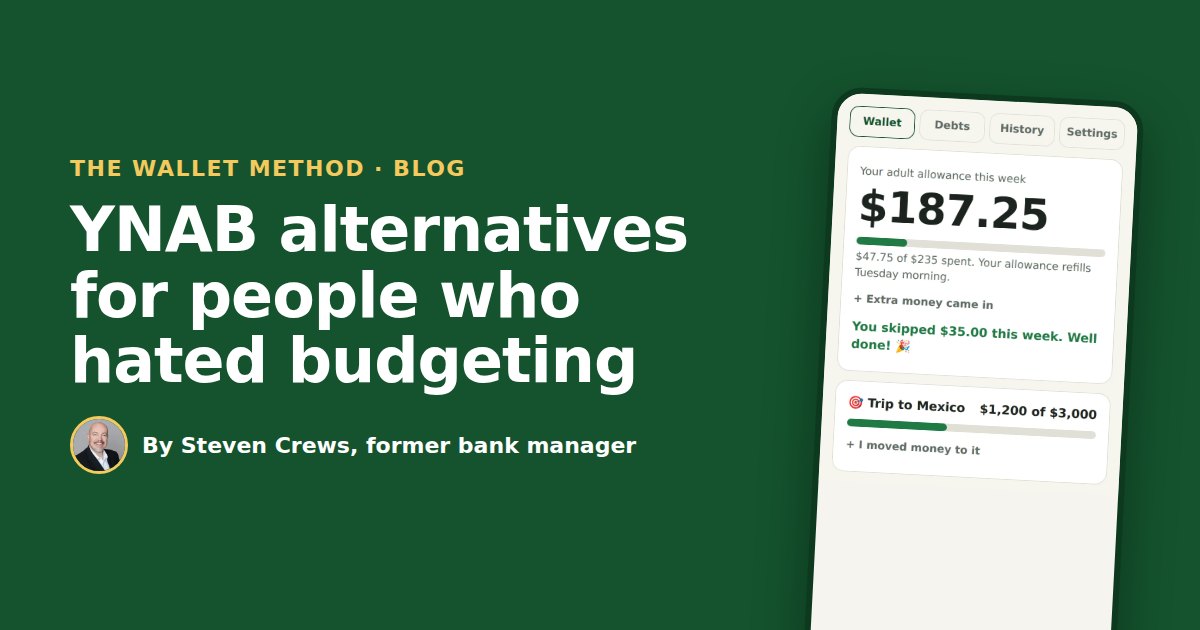
The Wallet Method. Free when you type it in yourself. Uploads are US$9 a month or US$68 a year (CA$11 or CA$95). It never asks for a bank login, and the plan stays on your phone. There are no categories. You get one weekly adult allowance: a weekly adult allowance. That is what you can spend. Your pay goes into a pot, and your weekly allowance stays the same, so the plan does not break when your pay changes. Debt paydown is built in, smallest balance first.
The founder put it this way on the home page: "I spent years as a bank manager and mortgage broker, going through people's statements with them. I never liked budgeting either. When I ran a cash flow plan for my own money, I ran it with cash."
Best for: people who hated budgeting, people whose pay changes, and people who will not hand a bank login to anyone. Not for: people who love detailed categories. If you want to know what you spent on coffee in March, YNAB does that and we do not.
Side by side
| App | Price | Needs your bank login? | How you budget | Works when pay changes? |
|---|---|---|---|---|
| YNAB | US$109/year or US$14.99/month, plus tax; free trial | Optional (you can enter transactions by hand) | Every dollar gets a job, in categories | Yes, you redo the jobs |
| EveryDollar | Free version; Premium US$79.99/year | Optional (bank connect is in Premium) | Zero-based, categories | Yes, you redo the categories |
| Monarch | US$99.99/year or US$14.99/month | Optional (manual accounts) | Fixed, once-a-year, and one monthly spending number | Yes, you change the monthly number |
| Goodbudget | Free plan; Premium $10/month or $80/year | Optional (sync is Premium, US banks only) | Envelopes | Yes, you refill the envelopes |
| Actual Budget | Free, open source; paid hosting via PikaPods | Optional | Categories, local app | Yes, you redo the categories |
| Spreadsheet | Free | No | Whatever you build | If you rebuild it |
| The Wallet Method | Free by hand; uploads US$9/month or US$68/year | No, never | One weekly adult allowance | Yes, pay goes in a pot and the weekly allowance stays the same |
How to pick
When you quit last time, what did you quit on?
- The price: try EveryDollar's free version, Goodbudget's free plan, or Actual Budget. Same style of budgeting, no bill.
- The bank login: most apps let you skip it and type things in, but they are built around it. A spreadsheet or the Wallet Method never asks.
- The categories: apps that still use them will lose you again. Pick a spreadsheet with three columns, or the Wallet Method with one weekly allowance.
- Your pay changes: look for a tool that keeps your pay and your spending apart. That is the whole idea behind the pot and the weekly allowance.
Whatever you choose, pick the one you will still open in six weeks. The best budgeting app is the boring one you use.
If the one-number idea sounds like your speed, the free Wallet Method app runs in your browser, with no bank login.
And if debt is the real reason you are here, try our free debt snowball calculator. Put in your balances and it shows the order to pay them off, smallest first.
Questions
Is there a free YNAB alternative?
Yes, several. EveryDollar has a free version. Goodbudget has a free-forever plan with 20 envelopes. Actual Budget is open source and free to run yourself. A spreadsheet is free. The Wallet Method is free when you type your numbers in by hand. The paid parts of each one are mostly bank sync and extras.
What replaced Mint?
Nothing replaced it one for one. Intuit shut Mint down, and users lost access in March 2024. Intuit pointed people to Credit Karma, but the budgeting and custom categories did not move over. If you want a budget, pick from the list above. EveryDollar, Goodbudget, Actual Budget, and the Wallet Method all have a free way in.
Which budgeting app doesn't need my bank login?
The Wallet Method never asks for one. Actual Budget treats bank sync as optional. Goodbudget's free plan has no bank sync. EveryDollar's free version does not include bank connect. YNAB and Monarch both let you enter things by hand, though most people link their bank. And a spreadsheet has no login to give.
Is it worth going back to YNAB?
If you like giving every dollar a job and you will open the app every week, yes. It is the most detailed tool on this list. If you quit in week two last time, the price was not the problem. The method was. Try a simpler one first.