Sinking funds: how to stop once-a-year bills from wrecking your month
 By Steven Crews, former bank manager and mortgage broker · November 1, 2026
The car insurance comes due. The kids need new shoes for school. Christmas lands, same as every year. None of these are surprises. But they feel like surprises, because the money for them is not there when they arrive. The month was fine, and then one bill wrecked it.
A sinking fund fixes that. It is a simple idea with an odd name. Here is what it is, the usual categories, and how to work out yours.
What is a sinking fund?
A sinking fund is money you set aside, a little at a time, for a cost you know is coming. You know roughly how much. You know roughly when. So instead of paying it all in one bad month, you pay a small piece of it every week, and by the time the bill arrives, the money is waiting.
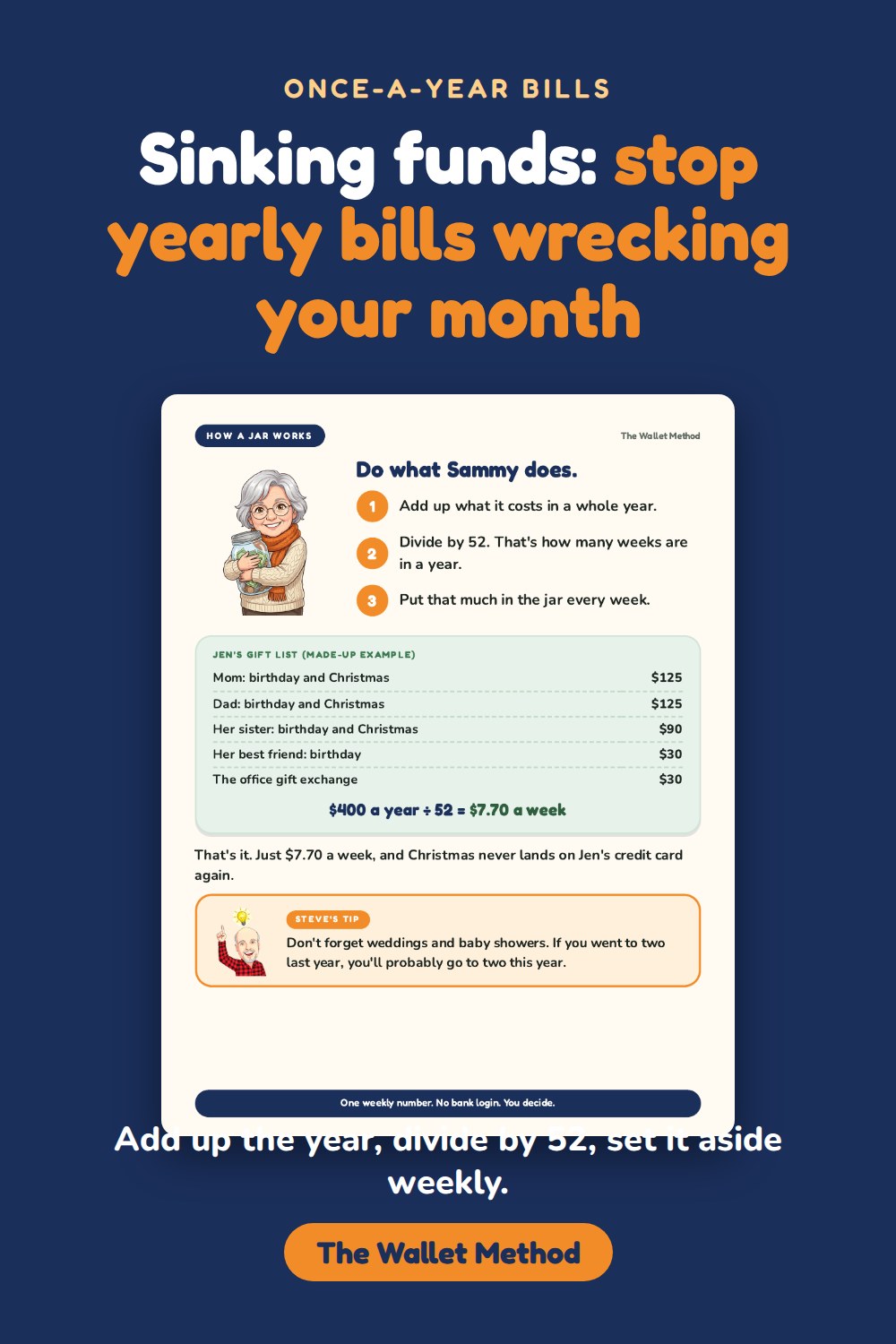
For example, say your car insurance is $600 a year, paid once. That is $50 a month. Or $11.54 a week ($600 divided by 52). Put $11.54 aside every week and the $600 is there on the day the bill comes. The bill did not change. It just stopped being a shock.
That is the whole trick. You turn a big once-a-year number into a small every-week number. The big number was never the problem. The problem was meeting it all at once.
Sinking fund vs emergency fund
These two get mixed up, so here is the line between them.
A sinking fund is for a cost you can see coming. You know the amount, or close to it, and you know about when it lands. Insurance. Gifts. A yearly membership.
An emergency fund is for the things you cannot predict. A job loss. The furnace dying in January. A big repair out of nowhere. You do not know the amount or the date, so you keep a cushion and hope you never need it.
You want both. The sinking fund keeps known bills from eating your emergency fund. The emergency fund covers what no list could have warned you about. In the Wallet Method, they live in different places. The emergency fund is part of Pay Myself, your savings. Sinking funds are jars, and we will get to those below.
Sinking fund categories
Which costs need a fund? Anything that comes once in a while and blows up the month it lands in. The usual list looks like this:
- Gifts. Birthdays, Christmas, weddings.
- Holidays. The food, the decorations, the trip to see family.
- Clothing. Winter coats, work shoes, the growth spurt.
- Kids' activities and back-to-school. Sports fees, supplies, the September shopping run.
- Pets and the vet. Shots, checkups, the thing the dog ate.
- Personal care. Hair, beauty, a massage now and then.
- Yearly memberships. Costco, Prime, anything billed once a year.
- Insurance and car repairs. Yearly premiums, tires, brakes.
You will not need all of these. You may need some that are not here. The list is a starting point, not a rule.
Here is what a few of them might look like as weekly amounts. For example:
| Category | Per year | Per month | Per week |
|---|---|---|---|
| Car insurance | $600 | $50 | $11.54 |
| Gifts | $300 | $25 | $5.77 |
| Holidays | $520 | $43.33 | $10 |
| Clothing | $1,200 | $100 | $23.08 |
Add those four up and it is $2,620 a year. Divided by 52, that is about $50 a week. Fifty dollars a week, and four of the bills that used to wreck a month are handled before they arrive.
How to work out yours
You do not need to guess. Last year already told you the answer. Here is the method.
- List last year's surprise costs. Go back through twelve months of statements. Write down every cost that was not a normal weekly expense and not a monthly bill. The insurance renewal. The vet. The Christmas spend. The new tires. Anything that made you say "where did that come from."
- Add them up. One total for the year. Do not round anything down to make yourself feel better. Last year's number is next year's number, give or take.
- Divide by 52. That is your weekly amount. Set that much aside every week and next year's surprises are already paid for.
For example, if your list adds up to $2,620, then $2,620 divided by 52 is $50.38 a week. Call it $50. If it adds up to $1,200, that is $23.08 a week. If it is $300, that is $5.77.
If the weekly number makes you wince, that is useful. It means those costs were always there, hitting you in lumps. Now at least you can see them. Start with the categories that hurt the most and add the rest when you can.
Where to keep sinking funds
There are two common ways.
The first is a separate savings account. You move the weekly amount over, and you move it back when the bill comes. This works. The weak spot is that one account holds every fund at once. So you have to remember that the $400 sitting there is, for example, $250 for insurance and $150 for Christmas, not $400 for whatever you want.
The second is jars. This is how the Wallet Method does it. When you set up the app, it asks about the costs that come once in a while and blow up a month. Each one becomes a jar that sits beside your weekly adult allowance. You enter the yearly amount, and the app divides it by 52. Every refill day, that slice goes into the jar. When you pay the vet, the money comes out of the Pets and vet jar, not out of this week's allowance.
The app comes with jars for Gifts, Clothing, Personal care, Kids' activities and back-to-school, Pets and vet, Holidays, and Yearly memberships. You can add your own for anything else on your list.
Jars are the old envelope idea, done on a phone. The founder put it this way on the home page: "I spent years as a bank manager and mortgage broker, going through people's statements with them. I never liked budgeting either. When I ran a cash flow plan for my own money, I ran it with cash."
Which one is right for you? Whichever one you will keep doing. A jar you look at every week beats a savings account you forget about. A savings account you actually use beats a jar you never set up.
If you want the jars done for you, the free Wallet Method app runs in your browser. Type in the yearly amount for each cost, and it works out the weekly slice and fills the jars every refill day. No bank login, ever.
Questions
What is a sinking fund?
A sinking fund is money you put aside a little at a time for a cost you know is coming, so it does not land all at once. For example, $600 of car insurance a year becomes $11.54 a week. When the bill comes, the money is already there. It is the opposite of a surprise bill, because you saw it coming and paid for it in slices.
Sinking fund vs emergency fund: what is the difference?
A sinking fund is for a cost you can predict. You know roughly how much and roughly when. An emergency fund is for what you cannot predict, like a job loss or a big repair. Keep both. Sinking funds stop known bills from draining your emergency fund, and the emergency fund covers the rest. In the Wallet Method, the emergency fund is part of Pay Myself, and the sinking funds are jars.
How many sinking funds should I have?
As many as you have lumpy costs, and no more. Start with the two or three that hurt most last year. Add one when a new cost catches you off guard. If a jar sits unused for a year, fold it into another one. The right number is the one you will keep filling every week.
Where should I keep my sinking funds?
Somewhere you can see them apart from your spending money. A separate savings account works if you keep a note of what each dollar in it is for. Jars in the Wallet Method app keep that note for you. Each cost gets its own jar, it fills every refill day, and spending from it comes out of the jar, not your weekly allowance. Pick the one you will check every week.