Pay yourself first: the one budgeting rule that actually sticks
 By Steven Crews, former bank manager and mortgage broker · October 29, 2026
Most budgets fail the same way. You plan to save what is left at the end of the month. Then the month ends, and nothing is left. Pay yourself first flips that order. Your savings come out on the day you get paid, before anything else. Then you live on the rest.
That is the whole rule. It fits in one sentence, and it is the habit everything else in a budget depends on. Here is how to set it up, and what to do when money is tight.
What "pay yourself first" means
Your paycheck lands. Before you buy groceries, before you fill the tank, before you pay the phone bill, a set amount moves to savings. It happens every payday, by itself.
"Yourself" means your future. In the Wallet Method, that money goes three places: an emergency fund, retirement, and your goals. A trip, a car, a down payment. The app calls that line "Pay Myself," because that is what it is.
Everything else, the rent, the bills, the spending, comes after. Savings is not last on the list. It is first.
Why "save what's left" never works
Saving what is left sounds sensible. It is also the plan most people have, and it is the one that fails.
Here is why. Spending grows to fill the room it is given. If your savings sits in the account you spend from, it looks like spending money. A dinner out, a sale, a repair you did not plan for, and it is gone. Nobody decided not to save. There was just nothing left.
The fix is not more willpower. The fix is to make the choice once, instead of every day. Move the savings before you can see it. Then what is left really is yours to spend, with no guilt.
How to set it up
- Pick an amount. Start small. A small fixed amount, or a small percentage of your pay, is a fine place to begin. The amount matters less than the habit. You can raise it later.
- Give it a separate home. A savings account at the same bank is fine. The point is that it is not in the account you spend from.
- Set an automatic transfer on payday. Tell your bank to move the money the same day your pay lands. Not the day after. Not when you remember. Payday.
- Leave it alone. The transfer does the work now. Your only job is to not undo it.
Pay yourself first, then one weekly adult allowance
Pay yourself first answers one question: how much do you save? It does not answer the next one: how much can you spend? The Wallet Method answers both, in two steps.
Step one. Your pay comes in. Bills and savings come out first. Bills are the things with a due date. Savings is your Pay Myself amount.
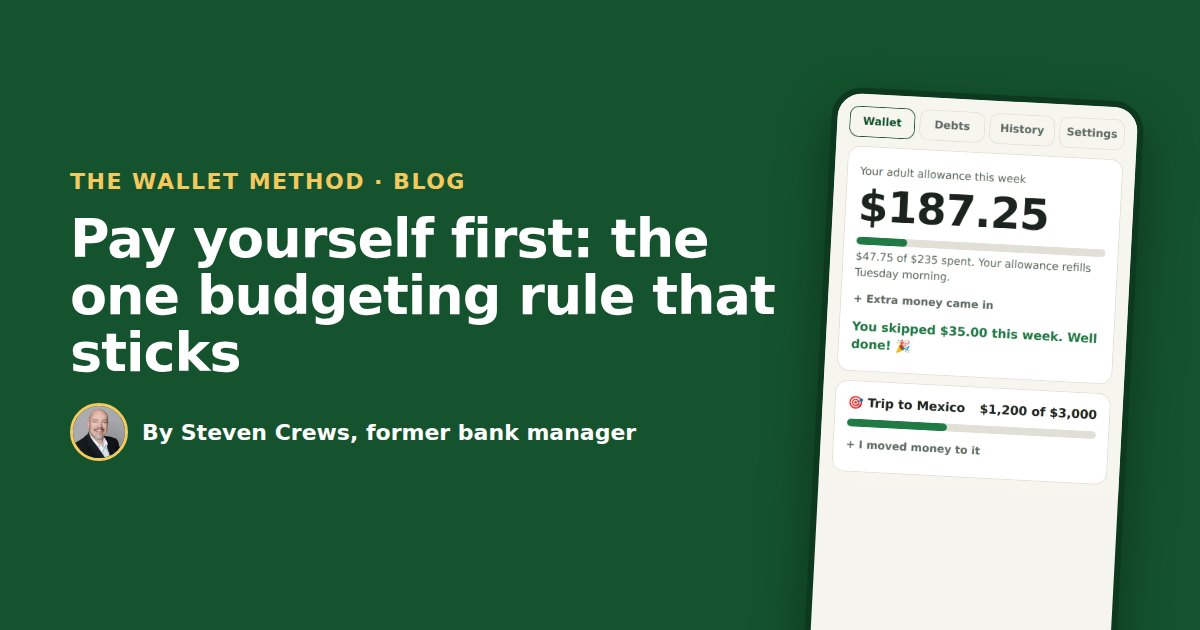
Step two. What is left becomes one weekly number: your weekly adult allowance. In the app, it sits in your wallet. It refills on the same day every week. That is the money for the spending you choose: food, gas, coffee, a night out. No categories. One number.
Before you tap your card, you ask one question: is this worth it, out of this week's wallet? If yes, buy it. If no, skip it. Either way, the savings already happened.
Here is a worked example, with round numbers. For example, say you bring home $1,000 a week.
- Bills: $500 a week, set aside for rent, phone, car, and insurance.
- Pay Myself: $100 a week. Say $50 to an emergency fund, $25 to retirement, and $25 to a goal.
- Adult allowance: $400 a week, for everything you choose to spend.
$500 plus $100 plus $400 is $1,000. Every dollar has a place, and you only think about one number: the $400.
An adult allowance is the old cash-in-your-pocket idea, done on a phone. The founder put it this way on the home page: "I spent years as a bank manager and mortgage broker, going through people's statements with them. I never liked budgeting either. When I ran a cash flow plan for my own money, I ran it with cash."
What if your pay changes every month?
Tips, commissions, gig work, shifts that come and go. Pay yourself first still works. It needs a pot.
Your pay goes into a pot. You pay yourself the same steady amount from the pot each week. Big months fill the pot. Slow months draw from it. Your Pay Myself amount and your wallet stay the same, because they come out of the pot, not out of whatever landed on Friday.
For example, say your plan takes $1,000 a week out of the pot: the $500 in bills, the $100 Pay Myself, and the $400 wallet from above. In a four-week month where $5,000 comes in, you take out $4,000, and $1,000 stays in the pot. In a four-week month where only $3,000 comes in, you still take out $4,000. The pot covers the $1,000 gap. Over those two months, $8,000 came in and $8,000 went out, and your savings never skipped a week.
What to do in a tight month
Some months the car breaks. The hours get cut. Something has to give, and it is tempting to quit saving for good.
Do not quit. Shrink it, and put a date on it.
In the Wallet Method app, a tight month is a planned break. The app suggests lowering your Pay Myself amount for 4, 6, or 8 weeks, and it suggests half. Then it sets the date to put it back, so the break does not become the new normal. You tell your bank to change the automatic transfer, and you change it back when the date comes.
Using the example above: your Pay Myself drops from $100 to $50 for six weeks. That frees $50 a week to catch up, on the bill that broke the month or on the card. Six weeks later, the transfer goes back to $100, and you never fell out of the habit.
A pause with an end date is a plan. A pause without one is just stopping.
If you want the two steps done for you, the free Wallet Method app runs in your browser. Type in your pay, your bills, and your Pay Myself amount, and it gives you your weekly adult allowance. No bank login, ever.
And if debt is what stands between you and saving, try our free debt snowball calculator. Put in your balances and it lines them up smallest first, and shows the interest you save compared with paying only the minimums.
Questions
How much should I pay myself first?
Enough that it happens, and not so much that you raid it by Thursday. We suggest starting with a small fixed amount, or a small percentage of your pay, whatever feels easy. The habit is the point. Once a few paydays go by and you do not miss the money, raise it a little. If you keep raiding it, lower it and keep going. A small amount that moves every payday beats a big amount that moves once.
Should I pay myself first if I have debt?
We think yes, but keep it small. The reason is the emergency fund. Without one, the next surprise bill goes on the card, and the debt grows again. So pay yourself a little first, enough to build a cushion, and send the rest at the debt. The Wallet Method lines debts up smallest balance first and shows the interest you save compared with paying only the minimums.
What if my pay changes every month?
Use a pot. Your pay goes into the pot, and you pay yourself the same steady amount out of it every week. Big months fill the pot. Slow months draw from it. The Pay Myself transfer and your weekly adult allowance stay the same size, so the plan does not break when a slow month comes. In the Wallet Method app, the pot is built in.
Where should the money go?
Three places, in the Wallet Method: an emergency fund, retirement, and your goals. If you are starting from zero, the emergency fund comes first, because it keeps you off the credit card. Once it has a cushion, split the Pay Myself amount across all three. You do not need the perfect split. You need the transfer to happen on payday.