How much allowance to give by age: a simple way to decide
 By Steven Crews, former bank manager and mortgage broker · November 4, 2026
Your kid asks for an allowance. Or you decide it is time. Either way, the first question is always the same: how much?
You can find charts online with a number for every age. Almost all of them come down to one rule. Here is that rule, where it comes from, and a simpler way to decide that fits your family and your budget. Then how the number should grow as your child does.
The common rule: a dollar a week for each year of age
U.S. Bank puts it this way in its guide for parents: "A common approach is to give $1 per year of your child's age each week." Their examples: "A six-year-old might get $6 per week" and "A 10-year-old might get $10 per week."
Here is what that rule gives you at each age. These are U.S. Bank's guideline, not ours. We just did the multiplication.
| Age | Per week (U.S. Bank's $1 per year rule) |
|---|---|
| 5 | $5 |
| 6 | $6 |
| 7 | $7 |
| 8 | $8 |
| 9 | $9 |
| 10 | $10 |
| 12 | $12 |
The same page adds a line that matters more than the table: "This guideline is flexible so you can adjust it based on your budget, your child's needs, and your family's goals."
So treat the rule as a starting point, not a price tag. If $8 a week for your eight-year-old is easy, fine. If it is not, pay less. The rule does not know your budget. You do.
Why the number matters less than you think
An allowance is not a wage. It is a practice run. The lessons come from what happens to the money after payday, not from how much landed in the jar.
Here is what we mean. A kid with $3 a week who spends it all on Saturday and has nothing on Wednesday learns the same lesson as a kid with $10 who does the same thing. The jar is empty. Payday is Saturday. That is the lesson, and it costs $3 or $10, your choice.
What matters more than the amount: it comes every week on the same day, they earn it, it gets split into three jars, and empty means empty until next payday. A small allowance you pay every single Saturday teaches more than a big one you pay when you remember.
A simple way to decide: four questions
Skip the chart. Answer these four questions and the number falls out.
1. What does it have to cover? For kids ages 6 to 12, our chore chart assumes the job is small: candy, a small toy, a trading card pack, and a goal they are saving for. If you want the allowance to also cover their school snacks or some of their clothes, the number has to be bigger, because the job is bigger. Decide the job first. Then the pay.
2. What can you keep paying in a bad week? The grown-ups page in our Sammy book says it in one line: "Pick a few chores and a weekly amount you can keep up." If the rule says $8 and $8 a week will pinch in a tight month, pay $5. A payday you skip because money was short teaches the wrong lesson. Pick the number you will never have to skip.
3. Does it split into three jars? In the Wallet Method, every payday gets split into SPEND, SAVE and GIVE. So pick a number that splits into whole dollars. Our chore chart suggests this: "start with half to SPEND, the rest split between SAVE and GIVE. You choose." For example:
- $5 a week: $2 Spend, $2 Save, $1 Give. That is Sammy's split in the book.
- $6 a week: $3 Spend, $2 Save, $1 Give.
4. Does the Save jar get them somewhere? Saving only teaches if the goal arrives. Look at what goes into Save each week and ask how long a real goal takes. At $2 a week, a $20 goal takes 10 paydays. That is long enough to feel the wait and short enough to reach the end. At 50 cents a week, the same goal takes 40 paydays, which is most of a year for a child to wait. If the Save slice is too thin to reach a goal in a couple of months, raise the allowance or lower the goal.
Answer those four and you have your number. If it lands near U.S. Bank's rule, good. If it lands under it, also good. It is your budget.
How it should grow with age
The U.S. Bank page also gives milestones by age group. For ages 5 to 7: "Start small weekly allowance." For ages 8 to 10: "Increase amount and discuss trade-offs." For ages 14 and up: "Larger amounts tied to real expenses."
The simplest way to do that is a raise on every birthday. One dollar more a week each year, if you are following the rule, or whatever bump your budget allows. The raise is a good moment to add a chore too. A twelve-year-old can do more than a six-year-old, and the pay should say so.
In the early teens, the job changes. The allowance starts covering real things: the phone, gas, going out with friends. Our chore chart has an Earn It page for teens with jobs, pay, and a simple plan: "Save first (at least 1 of every 10 dollars)," the bills they pay, and "My weekly wallet: food, fun, everything else." At 18, they are ready for the Wallet Method itself: one weekly adult allowance, with bills and savings taken out first.
Earn it, or just hand it over?
This is the other question parents argue about. U.S. Bank's take: "Some families connect allowance to chores, while others do not." They describe three ways to do it: a set amount no matter what, pay for chores done, or a base amount plus extra for optional chores. Their conclusion: "Any of these options can work if you stay consistent and explain the rules clearly."
Our books and our chore chart are built on earning it. Rule one on Sammy's rules page is "Earn it." A kid who worked for the $5 knows what it took to get it, and that makes the empty jar on Wednesday mean something. But the U.S. Bank point stands. Pick one way, say the rules out loud, and do not change them mid-week.
Where to go from here
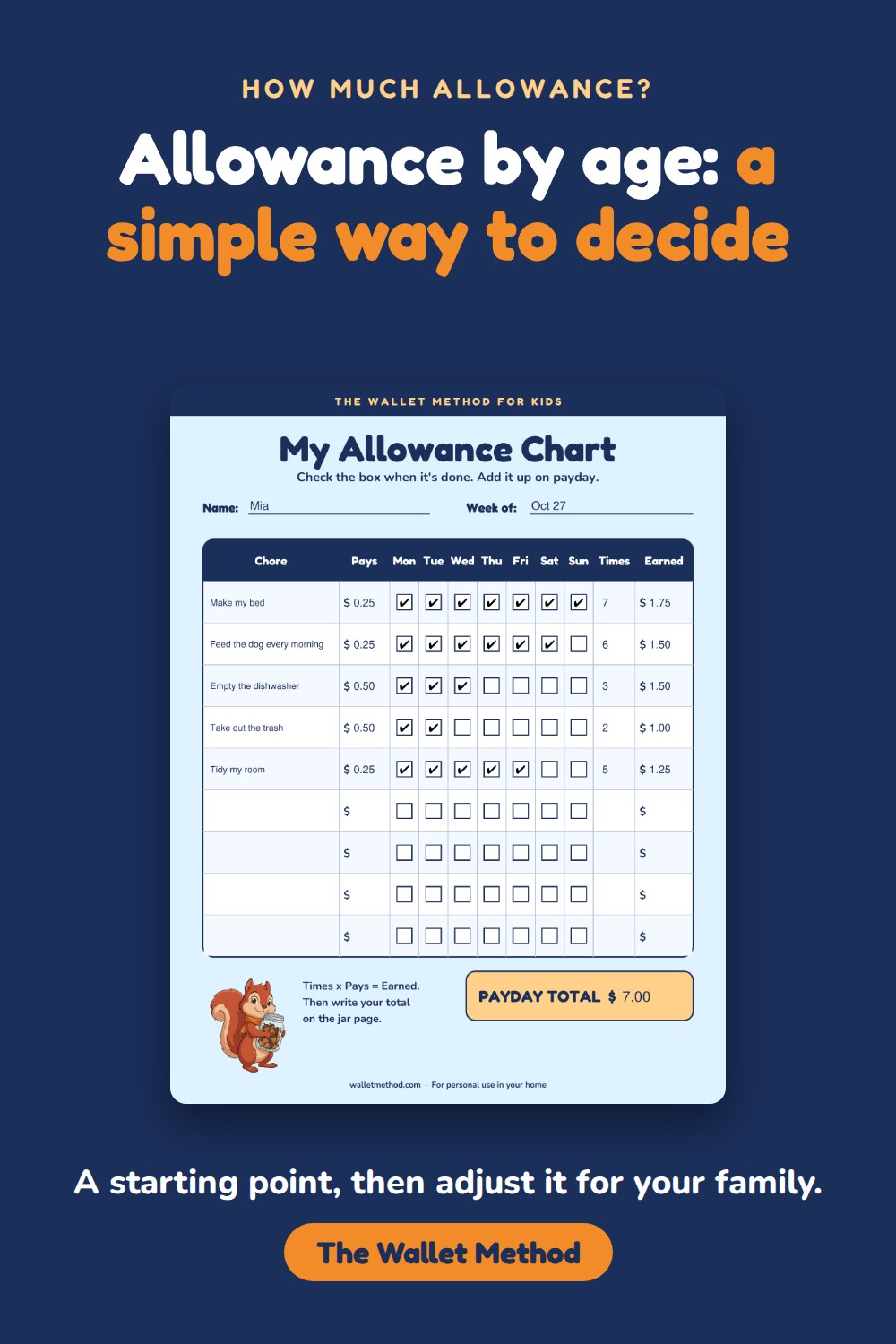
If you want the chores, the payday and the three jars on one sheet, the Allowance Chore Chart is six printable pages for ages 6 to 12. Up to nine chores with a price each, a payday log, jar labels, a savings goal to color in, and the teen page. You can type on it or print it.
If you want to explain the idea to a five-to-nine-year-old first, Sammy Gets an Allowance is a picture book where a squirrel earns $5 a week, splits it three ways, and saves for a red scooter.
And if you have never given yourself an allowance, the free Wallet Method app does for grown-ups what the jars do for kids. Type in your pay and your bills and it gives you one weekly adult allowance. No bank login, ever.
Questions
How much allowance should a 10-year-old get?
U.S. Bank's guide says: "A good allowance for a 10-year-old is often about $10 per week." That is their dollar-per-year rule. We treat it as a ceiling, not a target. Pick what the allowance has to cover, pick an amount you can pay every single week, and make sure it splits into Spend, Save and Give. If that lands at $6 for your ten-year-old, $6 is fine.
What age should allowance start?
U.S. Bank's guide says: "A good age to start giving allowance is around five to six." Their reasoning is that allowance works once kids can connect a choice with its result. Our picture books are written for ages 5 to 9, and the chore chart is built for ages 6 to 12. Start with coins and a few quarters if the child is young. The habit matters more than the amount.
Should allowance be tied to chores?
Families do it both ways, and U.S. Bank's guide says either can work if you are consistent and clear about the rules. The Wallet Method ties it to chores. Kids earn it, check it off, and split it into three jars. Our view is that money that was earned is easier to say no about later in the week. Pick one approach and stick to it.
Should I raise the allowance every year?
Yes, and the birthday is the easy moment to do it. If you follow the dollar-per-year rule, that is one dollar more a week each year. Add a chore at the same time so the raise is earned. In the early teens, shift the allowance toward real costs like the phone and going out, and move toward one weekly number for everything they choose to spend.